Project case study · Statistics · Psychology & Neuroscience · Research in progress
Psychemetrics Atlas: Latent dimensions, item coverage and the limits of personality measurement
An open, statistics-first investigation of SAPA public personality questionnaires. Explore the question, planned analysis, sample-design requirements and limitations, with explicitly preliminary real-data execution evidence.
01 · Context
Research question
How stable are exploratory personality item dimensions when respondents encounter only subsets of a large questionnaire?
02 · Methods
Approach
- Audit item codebooks, scales, reverse-coding and response coverage.
- Assess sparse pairwise overlap before estimating polychoric correlations.
- Explore oblique factor solutions, eigenstructure and item-level sensitivity.
- Separate unkeyed descriptive scale consistency from validated trait reliability.
- Audit all five 10-item IPIP-50 signed keys, original item-text mappings, reverse coding, completeness thresholds, and pairwise coadministration before trait-scale inference.
03 · Evaluation
Reported results
- Original Harvard Dataverse SAPA RData contained 23,679 respondent rows. Five ten-item signed IPIP-50 keys were checked against original item descriptions and response categories. In every scale, ZERO respondents supplied all ten responses, making conventional complete-case full-scale reliability inappropriate.
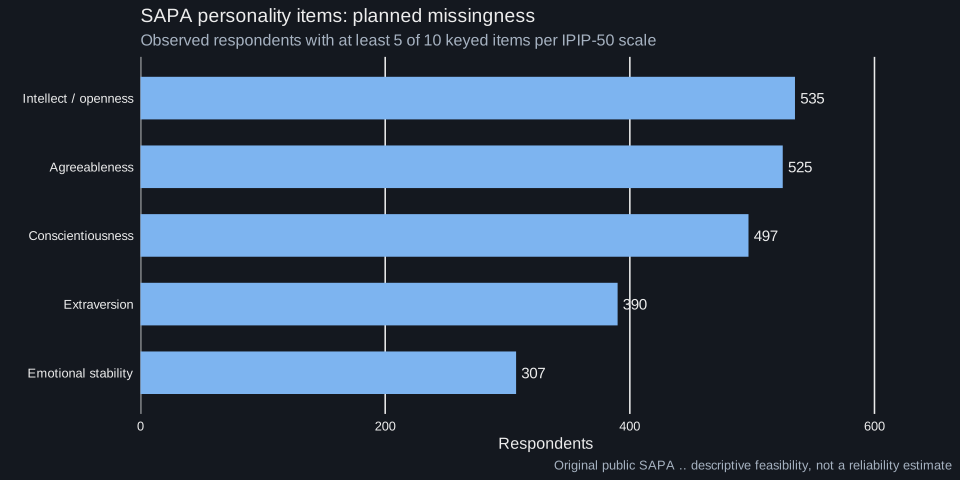
- With at least five of ten items answered, counts ranged from 307 to 535 per selected scale. Minimum pairwise item overlap per scale ranged from 289 to 523. Positive keyed pair correlations are exploratory association evidence—not a substitute for full-scale reliability, measurement invariance, or validity.
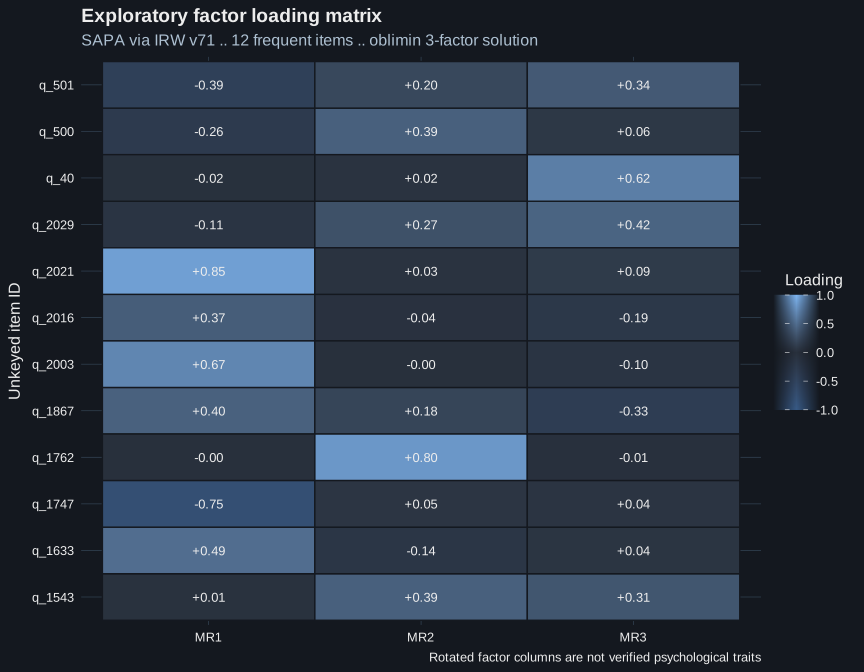
- The earlier IRW item-table transformation contains 23,678 respondent IDs and 2,039,803 observed item responses, with exploratory three-factor EFA of 12 high-coverage items. Source representations and their one-record count discrepancy have not been reconciled respondent by respondent.
04 · Scope
Limitations
Nonprobability volunteer sampling and extreme planned item missingness: no complete 10-item records in the selected IPIP-50 scales. Pairwise correlations are descriptive; no ordinary complete-case alpha, validated factor scores, invariance, or clinical conclusions. One-row discrepancy remains between original RData and the separate IRW transformation. Independent publication-level reproducibility is pending.
05 · Observations
Exploratory figures