Project case study · Research software · Offline-first · Provenance
ResearchOS: local-first research workflows with traceable evidence
A developing research-software workbench designed to make the path from source files and decisions to analysis outputs inspectable and recoverable.
01 · Context
Research question
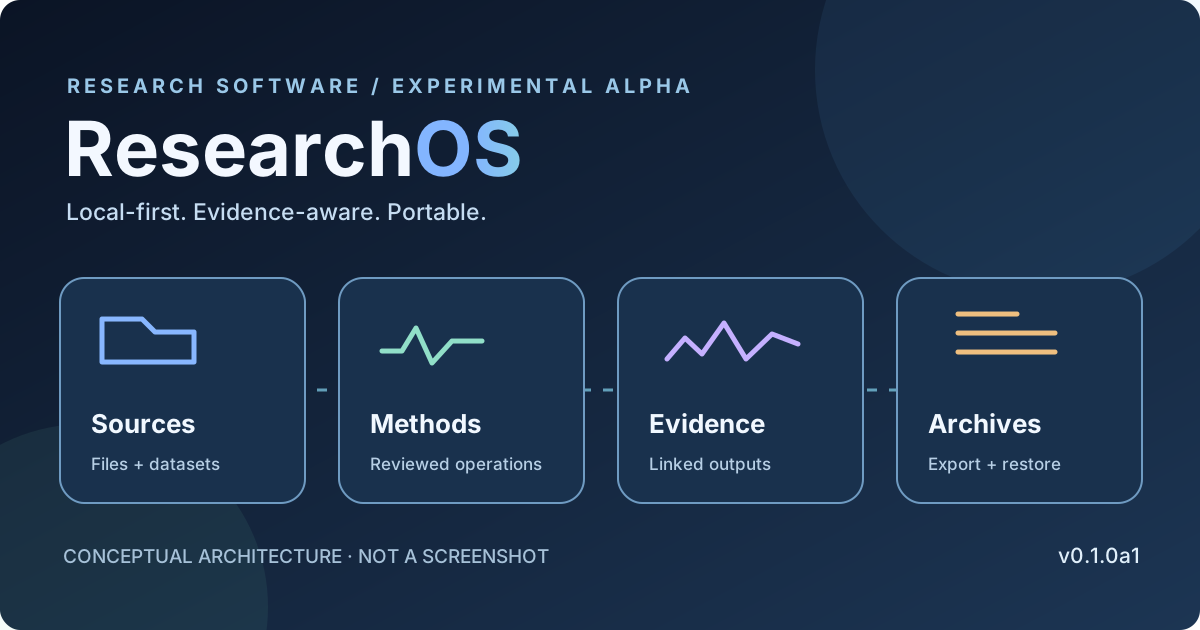
Researchers often maintain references, datasets, analysis results and decisions in separate tools and loose files. ResearchOS explores a single local project model with explicit artifact identity and operation provenance, so it becomes easier to revisit how a result was produced.
02 · Methods
Approach
- Implemented local project and artifact APIs backed by SQLite, with stored SHA-256 content digests and provenance relationships.
- Connected reviewed research methods, literature/evidence workflows and migration-related source modules through explicit operation interfaces.
- Built optional PySide6 guided desktop source and synthetic first-run examples while preserving offline-first workflows.
- Added source-level archive export and restore functionality, integrity checks and a fail-closed local test runner.
- Reconciled six worker code contributions into a public experimental Alpha 1 source snapshot.
03 · Evaluation
Reported results
- GitHub prerelease v0.1.0a1 was published on October 22, 2026, pointing to exact source revision 66ac400c301749462767da4b078e5f602eded8df.
- Six worker branches were structurally reconciled with no overlapping file changes in the integration step.
- A synthetic demonstration fixture and QA evidence report were published; an end-to-end combined application acceptance result is not claimed.
- No Windows, Linux or macOS installation package was attached as verified binary output.
04 · Scope
Limitations
Alpha 1 is an experimental source-code prerelease, not a production-ready or independently validated application. Combined pytest and native desktop tests, real installation, and adversarial archive/security acceptance remain unverified. Checksums establish byte integrity, not scientific validity. The repository lacks an explicit root LICENSE, so public source access does not automatically grant redistribution rights. Do not use for sensitive or clinical records.
05 · Observations
Exploratory figures