ARADMANAMNAOON/

EMOTIONAL APPRAISAL / REPEATED MEASURES

Emotion & Appraisal
Repeated-Measures Analysis

The file contains 13,264 observations, but only 434 distinct worker identifiers. Explore the nested structure and see why the number of rows cannot be used as the number of independent people.

Exploratory research: no unverified or causal claims. Original respondent-level data withheld.
DISTINCT WORKER IDs434FROM 13,264 ROWS
3,316 HITs4 rows per HIT
FOLLOW THE EVIDENCE01 / 04

01 / COUNT WHAT IS IN THE FILE

13,264 recorded rows.
Not 13,264 independent people.

Each HIT appears four times, and the same workers contribute multiple observations. Before testing an association, the analysis must account for what the rows represent.

OBSERVATIONS

13,264Rows are repeated measurements, not a headcount.

WORKER IDENTIFIERS

434Unique IDs in the file; not independently verified identities.

HITS

3,316Every HIT contributes four recorded rows.
✳

The audit in one minute: Dividing 13,264 rows by four gives 3,316 HITs. Counting worker IDs gives 434. These are three different units of analysis, and the distinction affects uncertainty and interpretation.

FOLLOW THE EVIDENCE, NOT JUST THE ROW COUNTTHREE CHECKS · ORIGINAL VALUES PRESERVED
01 · WHAT APPEARS
13,264

Recorded rows

A naïve analysis might treat every row as an independent person.

02 · WHAT I CHECKED
434

Worker IDs

The same worker IDs and HITs recur in the observations.

03 · WHAT CHANGED
+0.035

Worker-level ρ

The aggregated rank association (n = 432) is near zero; it is exploratory, not causal.
02 / CHECK THE ASSUMPTION

One dataset.
Two different quality flags.

Select each original rule and watch the flagged count change. The two variables have different definitions; neither can replace the other without the source rulebook.

CLICK TO EXPLOREINTERACTIVE / 01

AUDIT COUNTS · PRESERVED ORIGINAL DATA

0

Selected indicator

Indicator A0
Indicator B0

Comparable counts only within each definition. A switch reveals the preserved observations, not a cleaned or imputed dataset.

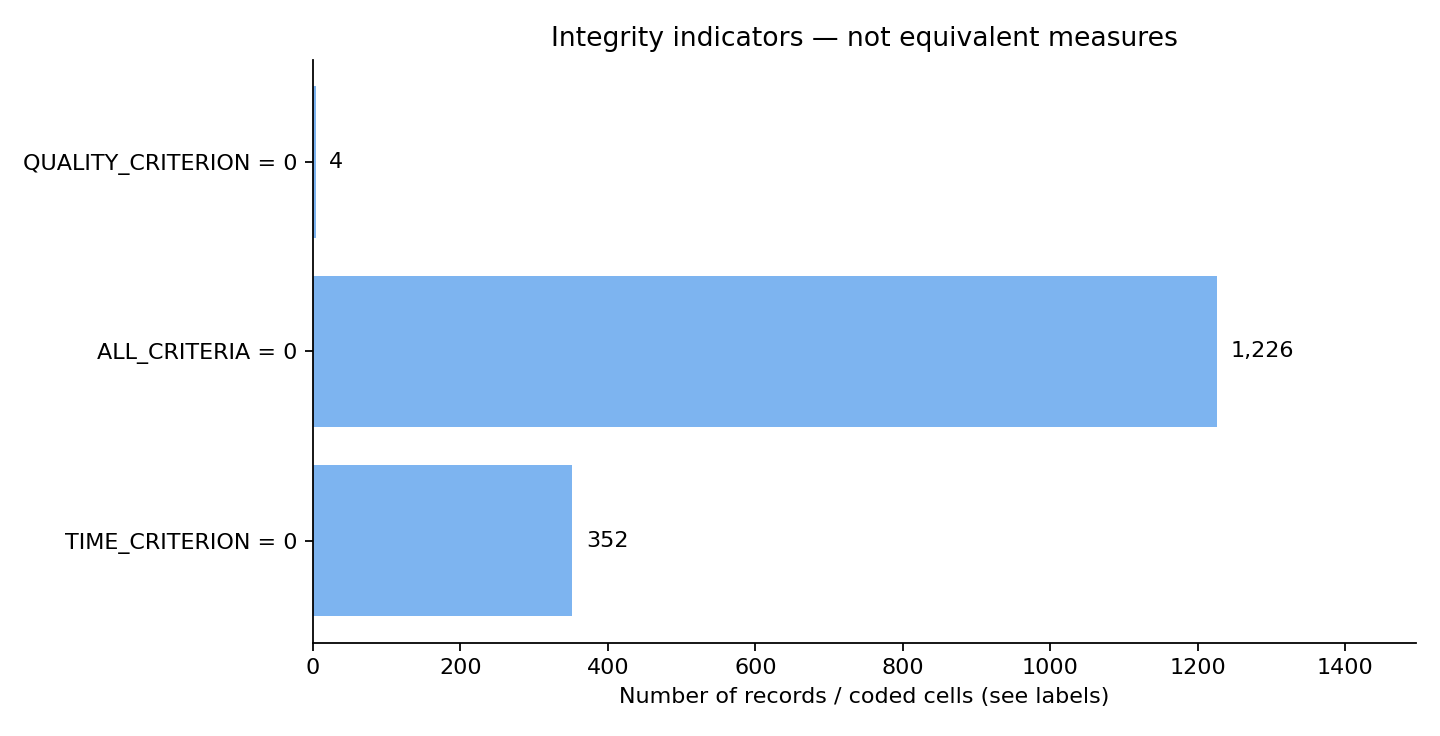
4 observations fail the individual QUALITY_CRITERION flag. That does not mean only four rows fail every quality rule.

Explore the evidence.

Data quality indicators

Hover or focus on bars for definitions. Filter to the largest observed indicator.

SVG ↘

These are counts with different denominators or meanings; consult report before comparing them as rates.

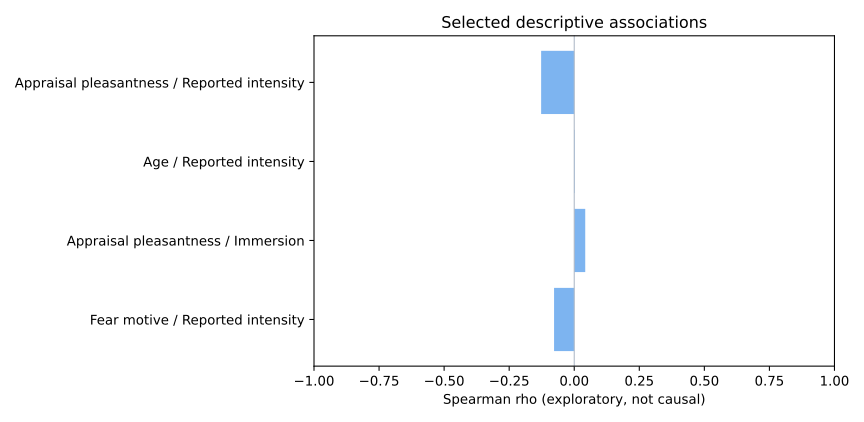
Exploratory correlations

Hover or focus on values for names, sample sizes and Spearman coefficients.

SVG ↘

-1 negative · 0 no monotonic rank relation · +1 positive

Exploratory diagnostics. Actual pairwise Spearman matrix. Cell denominators may differ; association is not causation.

03 / INTERPRET WHAT SURVIVES

A different unit of analysis
changes the inference.

The worker-aggregated Spearman correlation is +0.035 across 432 workers, nearly zero. A worker-intercept mixed model returned a negative slope but a singular random-effect fit. They answer different questions; the mixed-model uncertainty is not reliable.

THE CHECK THAT CHANGED THE INTERPRETATION
Treat every row as independent13,264

This is the row count, not the independent sample size.

Aggregate by worker ID432

Workers with complete values in the exploratory rank correlation.

These numbers describe different analytical units. The mixed-effects fit is singular and does not provide validated confirmatory inference.

01 / EXPLORATORY

Records are not people

What we found → 13,264 rows arise from 434 worker IDs, with four entries per HIT.

What to do → Treat workers and HITs as repeated structures rather than 13,264 independent participants.

02 / EXPLORATORY

Quality thresholds disagree

What we found → Only 4 rows fail QUALITY_CRITERION, while 1,226 fail ALL_CRITERIA.

What to do → Review every component flag before calling a dataset clean or unusable; preserve both views.

03 / EXPLORATORY

Aggregation changes the story

What we found → The worker-aggregated Spearman rho is +0.035 (n=432), while a singular worker-intercept model returns -2.377, a numerically unstable estimate requiring caution.

What to do → Report between-worker and conditional-model patterns separately, not as interchangeable effect estimates.

04 / EXPLORATORY

Extreme task durations remain visible

What we found → 24 rows have dur_in_sec above 24 hours; the recorded maximum is 312.24 hours.

What to do → Investigate collection logs and timestamp rules before quality filtering or interpretation.

Search the variable dictionary.

127 documented field names

Search by name, type, or special code. Descriptions are provisional wherever the original survey codebook is missing.

Get full dictionary ↘
DATA LIMITATIONS · UNRESOLVED
  • Worker IDs repeat across observations; treating 13,264 rows as independent people is incorrect. HITs and videos also repeat.
  • QUALITY_CRITERION and ALL_CRITERIA measure different combinations of checks. Their disagreement is not proof of a computation bug without the original rulebook.
  • Duration outliers exceed a day; preserved, not removed or truncated.
  • Item scoring and the provenance of coded variables have not been verified. FEAR reliability and component checks are diagnostic.
  • Missing responses are nonrandom across survey sections and need instrument/branching documentation.

The mixed model accounts for worker intercepts, not crossed HIT or video dependence. Neither the row-level nor worker-level result demonstrates causation.

04 / REPRODUCE THE CHECKS

Check the methods and evidence.

Every detailed statistical table, rule, assumption and limitation is available in the English report and reproducibility downloads. Raw participant records are not in this public preview.

PDF
Complete English reportMethods, findings and limitations
DOC
Editable English reportWord format for careful review
CSV
Aggregate resultsNo participant-level rows
DATA
Variable dictionaryField types, coded values and metadata
FIG
FiguresIntegrity and association charts, PNG and SVG
PY
Reproduction scriptTested locally with the supplied private dataset
MD
Reproducibility guideInstructions, source permissions and withheld files
BIB
References / citationsSource citations and method DOIs

Original participant-level CSVs and identifying fields are withheld. Two dataset sources lack verified license and DOI metadata; publication requires a manual rights/provenance check.